11.29.2011

Back to Basics - Quilter's Knot (Left-handed)

Today I would like to show you a step by step tutorial on the Quilter's Knot. I was taught this by my friend, Carol, as she taught me to hand quilt. It's a really easy knot that once mastered, you can do in a fraction of a second! This knot also has some great benefits to it that I'll go over after the tutorial.

* Please note these are the left-handed instructions. Just for you lefties out there!!! :]
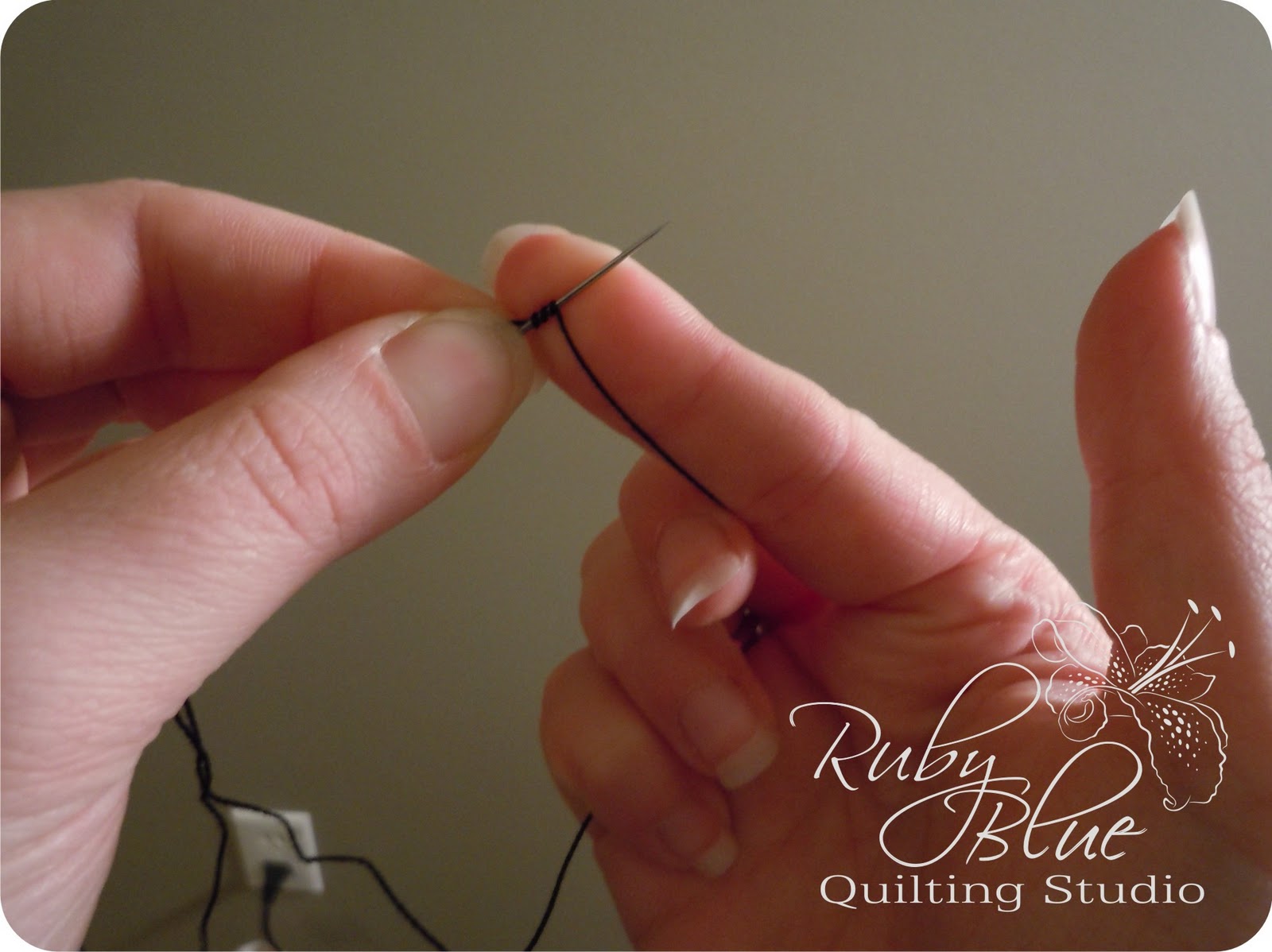
Step 1: Thread the needle, then hold the needle and the end of the thread towards each other, needle in your LEFT hand.
Step 2: Hold the end of the thread with the needle in your LEFT hand.
Step 3: Twist the thread around the needle a few times (more on this step at the end).
Step 4: Hold the twisted thread against your RIGHT finger and spin the thread (roll the needle along your finger) so there's no tail on the twisted thread.
Step 5: Grasp the twist of the thread between your 1st finger and thumb of your RIGHT hand.
Step 6: Guide the needle through the thread twist, pulling on the needle with your LEFT hand. Do not grasp the thread twist so much you can't pull the needle through, but have a firm grasp so you don't loose the thread twist either.
Step 7: Continue to grasp the thread twist and firmly pull the needle with your LEFT hand.
Step 8: Pull taught until you can feel the knot form in your RIGHT hand.
Step 9: You should have a nice knot!!!

This knot is very beneficial due to how it is made, with any pull against it will only strengthen the knot. This makes it wonderful for any aspect of quilting including embroidery, piecing, binding, etc.

Depending on the size of thread you are using, you may want to test the amount of times you circle the needle to get the appropriate size knot. Typically with Pearl Cotton I only twist once or twice around the needle where as Cotton Threads I may have 4 or 5 twists to get the right size knot.

There are several ways to knot your thread, but this seems the most simple and effective to me. I used to try other similar methods, but typically you would end up with a nice little rats nest at the end of the thread rather than a simple knot.

If you have any questions at all, please do not hesitate to ask, but try this knot out and I'm sure you'll fall in love with it like I did!

I am planning on doing a video tutorial on this as well in the near future, I just need a cameraman since both of my hands are a bit busy... I will post it soon and it might take some of the mystery out of this knot as well.

Back to Basics - Quilter's Knot (Right-handed)


Today I would like to show you a step by step tutorial on the Quilter's Knot. I was taught this by my friend, Carol, as she taught me to hand quilt. It's a really easy knot that once mastered, you can do in a fraction of a second! This knot also has some great benefits to it that I'll go over after the tutorial.

* Please note these are the right-handed instructions. I know several people that are left-handed and can have a hard time trying to learn in the opposite direction. I have taken that into account and will be featuring a separate tutorial specifically for left-handed instructions.
 Step 1: Thread the needle, then hold the needle and the end of the thread towards each other, needle in your RIGHT hand.
 Step 2: Hold the end of the thread with the needle in your RIGHT hand.
 Step 3: Twist the thread around the needle a few times (more on this step at the end).
 Step 4: Hold the twisted thread against your LEFT finger and spin the thread (roll the needle along your finger) so there's no tail on the twisted thread.
 Step 5: Grasp the twist of the thread between your 1st finger and thumb of your LEFT hand.
 Step 6: Guide the needle through the thread twist, pulling on the needle with your RIGHT hand. Do not grasp the thread twist so much you can't pull the needle through, but have a firm grasp so you don't loose the thread twist either.
 Step 7: Continue to grasp the thread twist and firmly pull the needle with your RIGHT hand.
 Step 8: Pull taught until you can feel the knot form in your LEFT hand.
Step 9: You should have a nice knot!!!

This knot is very beneficial due to how it is made, with any pull against it will only strengthen the knot. This makes it wonderful for any aspect of quilting including embroidery, piecing, binding, etc.

Depending on the size of thread you are using, you may want to test the amount of times you circle the needle to get the appropriate size knot. Typically with Pearl Cotton I only twist once or twice around the needle where as Cotton Threads I may have 4 or 5 twists to get the right size knot.

There are several ways to knot your thread, but this seems the most simple and effective to me. I used to try other similar methods, but typically you would end up with a nice little rats nest at the end of the thread rather than a simple knot.

If you have any questions at all, please do not hesitate to ask, but try this knot out and I'm sure you'll fall in love with it like I did!

I am planning on doing a video tutorial on this as well in the near future, I just need a cameraman since both of my hands are a bit busy... I will post it soon and it might take some of the mystery out of this knot as well.

11.28.2011

O Christmas Tree!

I did it! I decorated already and about 95% of my gifts are bought and wrapped. Don't you just love the little things?

11.21.2011

Happy Days!!!

No, not the TV show! It's the week of Thanksgiving! I get to relax for a day, throw the diet completely out the window, enjoy the day with family and friends. And my favorite part... I get to make this again:
This my friends, is a Pecan Bourbon Cheesecake in all it's ooey gloriousness. It was a hit a couple Thanksgivings ago and I haven't made it since, but I'm making it this week. Along with the staple of green bean casserole and I'm going to attempt to make the Amish Stuffing I ate at Das Essenhaus this summer - it was soooo good I still drool just thinking about it. I bought the recipe book and I hope it's as yummy as I remember!

Can I tell you a secret? I LOVE to cook!!! Especially for large numbers (like more than 2 people, not 100). Thanksgiving and Holiday get-togethers let me cook and cook recipes that I don't make for only Ben and I. I get it from my Nana, what can I say?!

Over the weekend I wrapped all of the Christmas gifts we've already bought, worked on the new stitchery quilts (Yay!) and did some other stuff... I'm trying to get the housework done tomorrow so I can bake the Cheesecake Wednesday and eat on Thursday!!! I'm so close to finishing a couple of the stitchery quilt tops (can I tell you they are just so stinkin' adorable) and I'm hoping to show those off later this week. I was thinking I would get at least 1 or 2 tops done by now, but I couldn't stop stitching. They're too freakin' cute!!!

So, my question for you is: What do you like to cook for Thanksgiving or what can you not have Thanksgiving dinner without?

My Nana is so awesome and makes everyone's favorite thing (Brian's mashed potatoes, Paul's apple pie, my buttermilk rolls, etc.). We all have our favorite thing and she makes sure there's something on the table for everyone. It just makes it that much more special. She's pretty cool like that :]

So, that's it for today. I have much more wonderful and exciting news to share later this week. I can't wait to hear all about your favorite Thanksgiving foods!!! (can you tell I've been dieting for over a month now? hehehe) Later!

11.18.2011

Back to Basics - Embroidery Threads


So, for me there's only really two types of threads I like to use for Embroidery... I know there are literally hundreds to choose from... Maybe one of these days when I'm feeling adventurous I might try some other styles, but for now these are the two I use the most.

Embroidery Floss - There's several colors to choose from, almost an endless supply it seems at times. There's even hand dyed versions like Weeks Dye Works that offer even more color options! The standard for floss is a 6 strand bundle that you then separate into the amount that you desire. Typically it's either 2 or 3 strands for the most popular applications.
* Pro - There are so many choices in color, you can always find the perfect color. The hardest part is deciding which colors to bring home with you! Also, being able to choose how many strands to use offers you the possibility to add the look of more texture within a project. You can really get a 3D effect with this thread.
* Con - Having to separate the strands is a pain to me - there I said it - a pain. Once you separate the strands and use 2 for example, the floss may want to keep separating, knotting, etc. It might take some getting used to working with this versus using only 1 strand of other threads.

Pearl Cotton - This is my go-to embroidery thread. Pearl Cotton comes in several colors and a few different sizes, the most popular being size 8 followed by size 5. I use size 8 for all of my stitcheries, it's equal to about 2.5 strands of embroidery floss. The thread is a wound thread that has a slight sheen to it and you only need one thread to get the job done. For this thread it's best to use an Embroidery needle that has a larger eye and a sharp point.
* Pro - You only have to use one strand of thread and it comes in several color to choose from (not as many as Embroidery Floss, but there's plenty to choose from)
* Con - The colors available may not match perfectly to your project, however most of the staples should be readily available, or something close that works. Remember though, you don't have to match the exact shade, but something close to it. After it's made, you may never know the difference!!!

Other tips that I have for these threads are:
* Cutting the thread - when cutting the thread off of the spool, ball , etc., Cut the thread at an angle and it will help to thread your needle!
* Twisting thread - if your thread seems to want to twist and knot while you are stitching, change the direction of the thread when you put it on the needle. What I mean is - most threads have a designated twist to them as they are made. They are designed to work best coming off of the spool, as if the needle is at the open end and the knot is a the cut end. If you do this and it doesn't work, then swap the direction of the thread. Knot the open end and put the needle on the cut end.
* Unrolling - The best tip for the balls of Pearl Cotton to keep them from unrolling that I have found is using a small hair tie (either those tiny rubber bands or the squishy mini scrunchy things) to wrap around the ball. They're the perfect size and keep everything neat and organized!!!

That should do it! I'll be back soon with my favorite knot of all time that changed my life!!! I have taken into account that I am right-handed and some people are not, so I will do two versions in a step by step picture tutorial, one for lefties and one for righties. And then with some help I will attempt a video of it too!

I'll keep adding in some tips from time to time for threads (there's a TON of topics to cover!) but I'm planning on moving onto other topics soon, like squaring up blocks, deciding on a quilt size if you're altering from the pattern, and putting on square and even borders effectively. Keep those ideas coming and I'll be sure to feature the topics you've asked for soon!


11.15.2011

Back to Basics - Thread

So, threads. Where do I begin? There are so many styles and choices! That's why I'm here - I'm going to try and sort out the differences of each type as well as give you some pros and cons on each!

So...to begin I'm going to start with the threads you would use in everyday piecing and quilting:

Cotton Thread - In quilting we use cotton fabrics, so cotton threads are a natural choice. The most popular weights of thread are 30-60 (the bigger the number the smaller the size of the thread) but I use a 40 weight most often. I use this type of thread for most purposes including piecing, quilting, and applique.
* Pro - Cotton threads will wear the same as the cotton fabrics over time, giving a pleasing appearance as well as feel.
* Con - Plain threads may lint a bit more during the piecing process, but with regular cleaning of your machine (blow out the bobbin case and other workings of the machine with canned air for example) this shouldn't be much of an issue.

Silk Finish Cotton Thread - Silk Finish threads are shinier than a plain cotton thread, but possess the benefits of regular cotton thread too.
* Pro - With the Silk Finish, top stitching has a much cleaner appearance and this style over regular cotton has less lint overall.
* Con - The cost of Silk Finish is slightly higher than regular Cotton thread.

Poly Thread - Made of polyester, Poly Threads are very similar to the Cotton threads above. They come in several colors and weights, but tend to have a look similar to Silk Finish threads. Since they are made from polyester, the threads may wear differently than the cotton fabrics resulting in  uneven wear over time (especially with a quilt that is intended to be used and abused), but with recent technological developments, poly threads are much better than they used to be.
* Pro - the smaller weights of threads are prefect for applique or binding where your stitches need to disappear (you can usually find these sold in small bobbin sizes in a variety of colors) and they also can enhance quilting designs with heavy quilting without taking away from the overall effect (since you're not looking at only threads)
* Con - These threads can be a bit more expensive than cotton and wear differently than cotton over time.

Glazed Quilting Thread (Hand Quilting Thread) - To my knowledge this thread usually only comes in one weight and is intended only for hand quilting. There are several colors this thread comes in so you can match the colors with any project you're working on - it's not just white or off-white anymore (yay!). The glaze or coating on the threads helps aid to protect the thread as it's pulled through the multiple layers several times during quilting.
* Pro - the glaze helps protect the thread, but also gives the thread some body which might take some time to get used to, but this also prevents knotting and unnecessary wear and tear.
* Con - You cannot use this in any machine (I repeat DO NOT use this in a machine!) and the colors seem limited compared to other styles, so the perfect color match might not be available (instead of 200+ colors to pick from you might only have 50).

Lastly, here some additional tips for the threads listed above that may come in handy :]
* Some older threads may still be good enough to use (even if they come from your Hubbin's Grandma's stash :] ). To test, cut off a piece about a foot long. Grab each end of the thread and pull with some force. If the thread holds, it should be good to go. If the thread breaks easily, toss it out or only use it as a decoration...

* You CAN use a cotton or silk finish thread to hand quilt. Best advice I have is to use smaller pieces of thread (around 18" long) and to treat the thread prior to stitching with a product like thread heaven or wax.
* If you're like me and tend to use a LOT of thread, I suggest getting a cone of thread. A typical spool of thread has about 500 yards on it. A cone has around 3000 yards giving you about 6 times the thread at about roughly triple the cost of a spool. It's a great deal if you make a ton of projects.
* For piecing I recommend using neutral color threads like off-white through gray or tan. If you're making something with lighter colors, use a lighter thread, or darker colors, use a gray or tan. Piecing stitches aren't supposed to show, but from time to time it happens. If you match the thread tone closer with the fabrics used and the stitches show, you won't have a white thread peeking out from behind a black fabric. This doesn't make the thread as noticeable...
* If you're having trouble with your sewing machine, try changing your thread. Sometimes machines are finicky and like a particular brand of thread more than another. Each machine is different so don't think (insert here) brand of sewing machine only works with (insert here) brand of thread. Sometimes to solve your tension, thread breaking, etc. issues it's as simple as trying a different brand of thread! I don't honestly know why it makes that much of a difference, but it does!

So, I think that's enough information for this session, don't you think? I'll be back soon with decorative threads and some other topics. I've been on an embroidery kick lately (like with these) and I'll show small tutorials on different embroidery stitches too!

I hope you're enjoying these topics as much as I've enjoyed gathering the information to share. Keep those ideas coming on what else you would like to learn and I'll be more than happy to feature that in an upcoming session.

11.11.2011

Happy Veteran's Day!

I would like to start by saying a HUGE thank you to all members who served, are serving, or aspire to serve this wonderful country of ours as well as the family members that stand by their side with support every single second of every day.

But I have a small bit of trivia - do you know why the flags are backwards on military uniforms???
So, I was curious on this myself so I researched it. Basically the flag is placed on the right shoulder or to the right of the soldier which is considered the place of honor. The flag is backwards representing the color guard that used to lead the troops into Battle. These days color guards are only used in formal procedures so the direction of the flag represents the soldier forging into battle, as if the flag was blowing towards them as the move forward...

Lots of details and representation from one little detail on a uniform! Thank you again and remember to honor the troops all days, not just today!

And in honor of my Father-In-Law - Semper Fi!

11.10.2011

Pantry Stir-Fry Recipe :]

Okie dokie - so Momma and I are doing the 17 Day Diet... So far so good (until Amish country that is) My will power is strong, but not THAT strong. And I wasn' t that bad... only a burger and some pasta... but it was worth it and now we're back onto the diet!!!

(I am not being paid to say anything about this diet program, but it's working for me and I know several others trying it out at the same time) Which brings me to the recipe - almost.

So, I'm on this diet. I can have all sorts of veggies and wonderfulness - but I have to limit the condiments and fats used... No butter, no starches, no flavor packets that have the 1st ingredient as corn starch, nada. So, I had to reinvent some of my usual recipes and I think I hit a home run with this one... Trust me!

I love condiments. I really do. We have a cabinet and a half that is nothing but BBQ sauces, salad dressings, A-1 varieties, mustards, ketchups - you get the idea... So I took those things I have on hand and twisted them into a sauce for Stir-Fry.

Pantry Stir-Fry
* 2 Chicken Breasts Cubed - Raw (or you can substitute your favorite meat here)
* Assorted Stir Fry Veggies - either fresh, frozen or both!
(I used 3 bell peppers, 1 each of green, orange and red, 1 onion, and frozen broccoli - but this is where the pantry comes in, use what you have on hand or what you prefer)
* 1 Tbsp Olive Oil
* Minced Garlic
* Yellow Mustard
* Lite Soy Sauce (or Stir Fry Sauce - again whatever you have on hand)
* Chinese Spices (I use a small squirt of Sriracha but if you have Chinese 5 Spice that would work too!)

* Also a small note - this is super quick so it makes a great fast dinner!!! Let's get started:

Alright, cut up your veggies if need be and set aside. I usually cut them into thin strips (think fajitas).

Cut up the chicken (or other meat) into bite size cubes.

Heat the oil on high in a skillet and cook the chicken until cooked through.

Add the vegetables starting with frozen first (if any) then add the fresh veggies next keeping the heat on high. You're going to basically flash cook the veggies so they're still crunchy.

At this point take the pan off the heat and add in the garlic - I add a huge scoop but if you prefer less garlic, add about a tablespoon, add a small amount of lite soy sauce (enough to color the meat - about half a tablespoon), squirt some yellow mustard over the top (about a half tablespoon) and a small pinch of Sriracha or other spices to add in the Chinese flavors.

* I have absolutely no precise measurements here - I learned from my Grandma Safick everything tastes better with a pinch of this, a squirt of that - but depending on your tastes you can add or remove some of the ingredients to your liking...

Mix it all up until all incorporated and serve warm. This makes about 4 decent sized meals in our house - but it's sooo yummy it sometimes only works out to 3 after seconds and nibbling... :]

Now, since there's no starches in here the sauce may be a bit runny - if you add in starchy vegetables it will help to thicken the sauce if that's what you prefer, but a little thickening flour or corn starch should do the trick too.

I started making this a few weeks ago and came across it by accident - I started cooking the chicken (which cooks quick) and then threw in the veggies (which cook quick) and realized I had no sauce planned so I opened the fridge and grabbed what I thought made sense... And I LOVED IT!!! I have made this at least once a week since then if not more than that... Oh, and I just thought it might be good with Shrimp or Pork - or a mixture for that matter. House Stir-Fry at home!

I hope you like it and next time I make it I'll add pictures. I thought of posting this recipe AFTER I devoured the serving I set aside for lunch today... Sorry!

I'm still reinventing some recipes to fit in within the parameters of my diet and I have to say it's been easier than I thought it would be - just not in Amish Country...ooops.

Well, let me know what you think of this recipe and if you have any other healthier recipes you would recommend! I'll be back soon with more details from my latest trip to Shipshewana!!!

11.07.2011

Marathon Day 1

So yesterday was the Annual Wildwood Quilt Guild show. The guild did a wonderful job, there were several beautiful quilts hanging, the refreshments looked and smelled awesome (I stuck to my diet, yay me!) and the vendors were all dolls as usual. Here's some pictures I took towards the end of the day.

Then Mom and I packed up her booth and headed up to Shipshewana, IN for the after Market Regional Show (only for shop owners, sorry). We'll be here for two days and we get to spend that time with Edyta Sitar from Laundry Basket Quilts!!! I'm so excited!!!

If I get a chance tonight I will try to take pictures today and post later. I hope this post turns out alright. It's the maiden post from my iPod on the road!

Be back soon after I love on all the new fabrics!!

11.04.2011

Back to Basics - Scissors


So, scissors... They don't seem all that important in the overall construction of a quilt or project, but let me tell you - they are VERY important.

I personally have a couple of pairs. Ideally, I would like to have 3, but I'll discuss more on that later.

So, my tips for a great pair of scissors are:

* Sharp!!! You want to make sure the scissors you use on fabric are really sharp. Any scissor used to cut fabric should NEVER cut paper, plastics, or other materials, only fabric. To get a nice crisp cut on fabric, scissors need to be extra sharp. If you use the same scissors to cut other materials, they can dull quite fast.

* Grip - Make sure the grip is nice and tight, without being too tight. You don't want to have them slip because you've lost your grip mid-cut, but you don't want them to cut off circulation either. Try several pairs out if possible and choose the pair that best suits your hand.

* Size - For different functions, it's good to have a different size of blade (or overall size of scissor):

I prefer to have a small pair for my little sewing kit for traveling and handwork - I actually have a sharp pair of kid's scissors that have a rounded end on them, that way I can take them on planes while traveling, but the blade must be under 4" long).

I also have my standard scissors that sit by my machine for all necessary purposes, trimming batting, cutting threads, etc. This should be the good old go-to pair.

I would also like to have a combination of a longer blade as well as the spring loaded feature for my third pair. This way they usually have the bottom blade stationary and the spring loaded action saves some wear and tear on your hands for long periods of cutting (like trimming back backing and batting from a quilted top). Also, the stationary blade will be a nice feature for this since it is less likely to "catch" on the bottom layer and screw up the "flow" of cutting. The longer blade should also come in handy to cut more with each cut saving time trimming back a large quilt or multiple projects all in the same timeframe. I'm looking for the right pair of these now and I hope to have some soon!

That's pretty much it for the features to look for, but before I go, I wanted to touch on a couple other options:

* I have seen electrical scissors advertised and to be honest - they scare the crap outta me!!! They cut really fast, you don't seem to have even 1/2 the control you do with manual scissors, and if you slip - who knows what damage might happen? I suggest if you're looking into this type of scissor, save the electric bill and your wrist - go for the spring loaded type.

* Sharpening blades - Like the above, there are several electric or "As Seen On TV" grade gimmicks out there claiming you can sharpen your own scissors and then cut through rocks (or something crazy to that effect...) I highly advise against sharpening your own blades. Not only is it dangerous, but more times than not, these gimmicks only damage your blades more than help. Many Local Quilt Shops have either an Event or actually have a service to sharpen blades for you. It's usually not that much money and it'll be better for everyone overall!!!

* Personalization - I know you may be asking yourself - seriously? personalization? Trust me - we have a group of friends that gets together once a month to rug-hook. Almost every single one of them owns the same pair of scissors. So how do you know whose is whose? I have a charm intended for a cell phone I got in Paris on mine, several of the girls got personalized beads with their initials to make their own at a local bead store, but you can use whatever suits you best. Local bead shops are a great place to start, but if your Husband drags you off to the electronic store to bore you to death (Hi Hunny!!!) start looking at the charms they sell by phone cases and phone accessories. They're mighty cute and from now on you'll know which scissors are yours.

So, that's basically it. The ins and outs of scissors. There's more to it than you thought, huh? Well, that's just the start of the Back to Basics segment. I'll be back soon about threads - the lovely luscious world of threads!!!

Keep the ideas coming!!! I have a good amount of topics to start off with, but as mentioned before, I want to teach you want you want to learn, so just let me know! You can shoot me an e-mail at rubybluequilts (at) gmail (dot) com or leave a comment on this post. It's that easy! I'll be back soon! Have a great weekend!

11.01.2011

Family Time!!!

This weekend Ben and I went to see our nephew, Shawn, and his Boy Scout Troop shoot off rockets they built! For a bunch of 8ish year olds, they did great!
 Here the older scouts are helping to set up each rocket, hook it up to the remote, and then...
 BLAST OFF!!! Shawn's rocket went really high and his parachute worked perfectly!
Here's Shawn showing off his rocket after the first launch. I don't think that smile could have gotten any bigger!!!

Later that evening we also went to see Ben's Step-Sister in a play, Arsenic and Old Lace. She played Elaine, the unknowing girlfriend of Mortimer... And she did awesome as well! Meghan has been in several plays in the past, but this was the first we were able to attend, and I'm so glad we did.

I'll be back shortly with the first installment of "Back to Basics". Keep the ideas and suggestions coming - I've gotten some great ideas so far and I look forward to this segment on the blog!!!
Related Posts Plugin for WordPress, Blogger...